
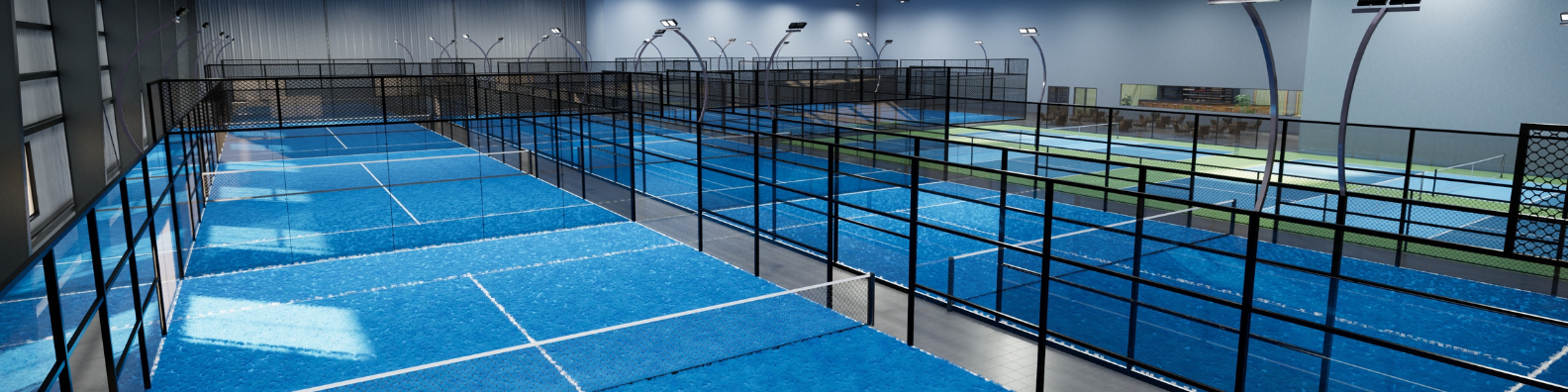
Pickleball and padel are no longer just recreational trends. Across Canada, they are quietly influencing demand for small- to mid-bay industrial space.
While they are not displacing core logistics or manufacturing users, racket sports operators are introducing new competition in specific size ranges and building types. For industrial tenants, this shift matters.
Here is what’s happening across major Canadian markets.
Greater Toronto Area Industrial Real Estate: Pickleball and Padel Driving Small-Bay Demand
In the Greater Toronto Area, pickleball and padel operators are emerging as a meaningful secondary demand driver for industrial space between 15,000 and 60,000 square feet.
They typically target:
- 20- to 24-foot clear heights
- Wide column spacing
- High floor loads
- Ample surface parking
- Underutilized infill industrial buildings
- Former big-box retail properties
These requirements closely mirror those of:
- Small-bay logistics
- Last-mile distribution
- Light manufacturing users
Where the Pressure Is Showing
Submarkets including Etobicoke, Vaughan, North York, and Oakville are seeing multiple bids from well-funded recreational chains. Vacancies that once catered exclusively to industrial users are now attracting sports operators.
In many cases, racket clubs are willing to match or exceed mid-teen net industrial rents per square foot, supported by strong membership demand.
The result:
- Sustained upward pressure on asking rents
- Increased competition for functional but older industrial stock
Where You’re Still Safe
Not all buildings are affected.
Modern facilities with:
- 30+ foot clear heights
- Strong highway connectivity
- Modern loading configurations
remain largely insulated from this trend.
The Real Risk: Reversibility
Padel courts, in particular, require costly and semi-permanent interior alterations. That creates uncertainty around reconversion to warehouse use.
For industrial tenants, the takeaway is: Move quickly on marginal assets. Buildings under 18-foot clear height, with limited loading or constrained truck access, are where competition is most acute.
Greater Montreal Industrial Market: Emerging Demand for Pickleball and Padel Facilities
In Montreal, Laval, and parts of Longueuil, racket sports operators are targeting 15,000 to 50,000 square foot industrial and flex buildings with 18- to 24-foot clear heights.
Proximity to dense residential neighbourhoods is key.
Zoning Matters
Montreal’s employment land protections and municipal scrutiny slow industrial-to-recreational conversions. That limits speculative activity.
As a result, operators focus on:
- Fringe industrial areas
- Mixed-use employment zones
- Older flex properties
Unlike the GTA, rents generally align with prevailing small-bay net rates rather than exceeding them.
Landlords remain cautious, particularly around:
- Reversibility
- Long-term demand durability
- Significant tenant improvements for padel installations
For tenants, this means older or marginal industrial assets may face competition from recreational users, while modern logistics facilities with 28 to 32-foot clear heights and strong highway connectivity remain largely insulated.
Western Canada Industrial Real Estate: Growth of Large-Format Pickleball and Padel Facilities
Western Canada has a longer history of recreational industrial users, from climbing gyms to indoor soccer and archery ranges.
Pickleball and padel have accelerated that trend.
Typical facility requirements:
- 40,000 to 60,000 square feet
- In some cases up to 100,000 square feet
- Large contiguous floor plates
- Higher clear heights
Industrial buildings are preferred for:
- Volume
- Ceiling height
- Lower rental rates relative to retail
Examples include:
- Inclusive Place of Pickleball in Burnaby
- The Nest in Delta, BC
Both demonstrate adaptive reuse of industrial-style structures, sometimes on commercially zoned land.
What This Means for the Market
Demand for sub-100,000 square foot industrial space is deepening.
However, landlord hesitation persists around:
- Durability of the trend
- Costly tenant improvements
- Glass-enclosed padel court installations
Smaller cities and towns still have limited indoor racket sports supply, suggesting additional runway for growth.
The result: stronger demand for industrial units under 100,000 square feet, increasing competition and adding depth to the tenant pool in this size range.
Atlantic Canada Industrial Market: Racket Sports Revitalizing Older Industrial Properties
In Halifax, Moncton, and St. John’s, demand for racket sports facilities is still emerging but steadily growing.
Typical requirements include:
- 10,000 to 30,000 square feet
- Building types: Former retail boxes, small industrial buildings, community-scale flex properties
- Key considerations: Ceiling height, parking, ease of conversion
Many are filling gaps left by traditional tenants consolidating or vacating older stock.
Here, recreational tenants are more stabilizers than rent drivers.
Lease rates generally align with prevailing industrial averages. However, landlords appreciate:
- Longer lease terms
- Limited competing demand
- Lower capital intensity for pickleball conversions
The relatively low cost of pickleball conversions compared with padel reduces barriers to entry and exit.
Impact is most pronounced on older, well-located industrial assets. Modern logistics product remains largely unaffected.
The Bottom Line
Racket sports are not redefining Canada’s industrial market, but they are reshaping competition at the margins.
They are absorbing older, functional inventory, tightening availability in the 15,000 to 60,000 square foot range, and adding new pressure on small-bay supply in key urban submarkets.
If you are pursuing infill product, lower clear heights, or flexible industrial space, you are no longer competing solely with logistics users.
The fix is strategic awareness.
Know where recreational demand is active. Move decisively on viable space. And underwrite reversibility risk before committing.
Because even secondary demand can influence pricing, availability, and negotiating leverage in today’s industrial market.

Charl Valbonard
Senior Market Research Analyst
Charl has been part of Landmark Advisory Services since 2022 and is an integral part of our Team.